Ask "which AI model is used the most?" and you get a different answer depending on who you count. Count people, and ChatGPT and Gemini win by a mile. Count companies paying for API access, and Anthropic leads. Count the raw tokens developers push through OpenRouter, a marketplace that routes API calls to hundreds of models, and a Chinese lab most consumers have never used comes out on top.
This page puts all three leaderboards side by side. Every number is traced to the company, survey or dataset that produced it, with its date. The OpenRouter figures are our own analysis of OpenRouter's public rankings data, pulled on November 7, 2026. We explain what that data does and does not measure in the methodology section, and we think you should read it before quoting those numbers.
If you build or sell AI products from outside the US, the split matters. The model your customers chat with, the one your developers call and the one enterprises pay for are often three different models.
Key Takeaways
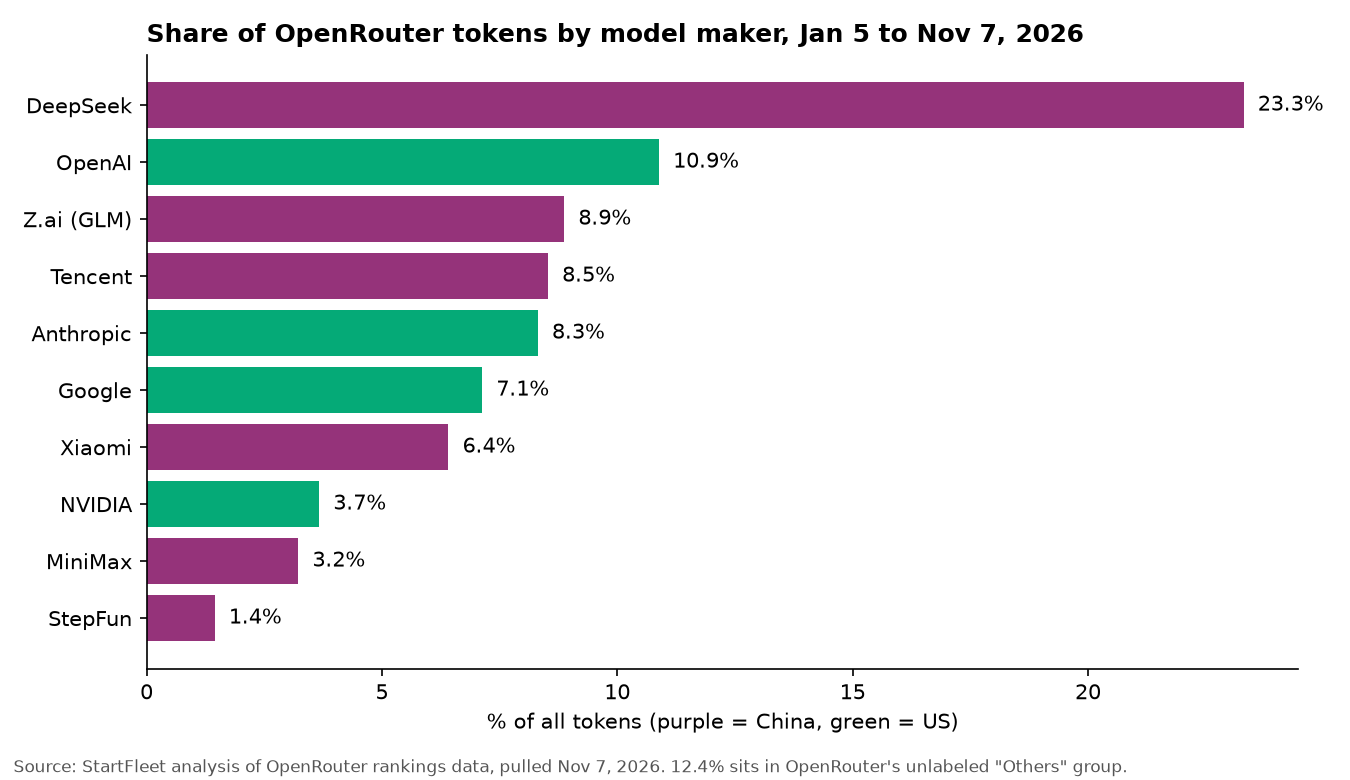
DeepSeek alone processed 23.3% of all tokens on OpenRouter in 2026, more than OpenAI and Anthropic combined at 19.2% (OpenRouter, Nov 2026).
Chinese AI labs handled 53.3% of OpenRouter tokens in 2026, against 31.3% for US labs (OpenRouter, Nov 2026).
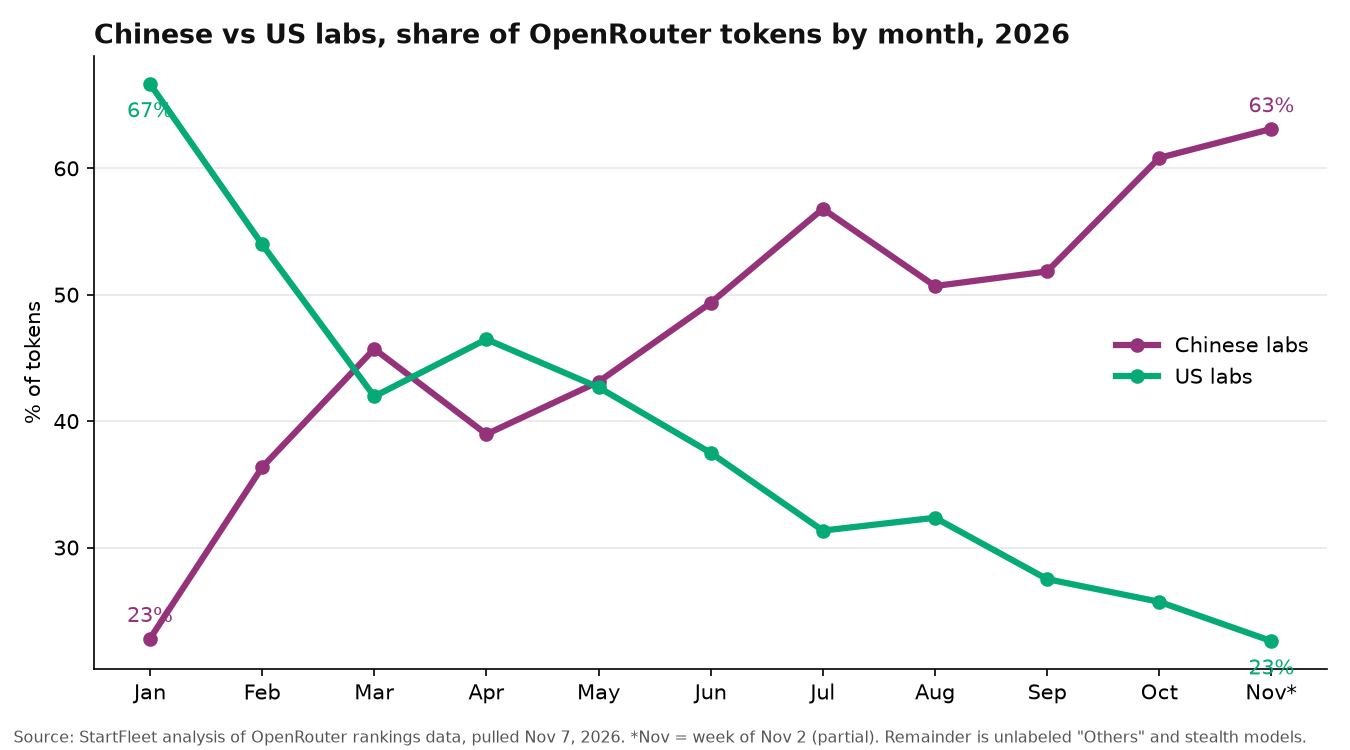
US labs' share of OpenRouter tokens fell from 66.7% in January 2026 to 22.6% in early November, while Chinese labs rose from 22.8% to 63.1% (OpenRouter, Nov 2026).
Open-weight models carried 75.4% of OpenRouter tokens in the week of November 2, 2026, up from 27.8% a year earlier (OpenRouter, Nov 2026).
The Gemini app has passed 1 billion monthly active users (Alphabet, Oct 2026).
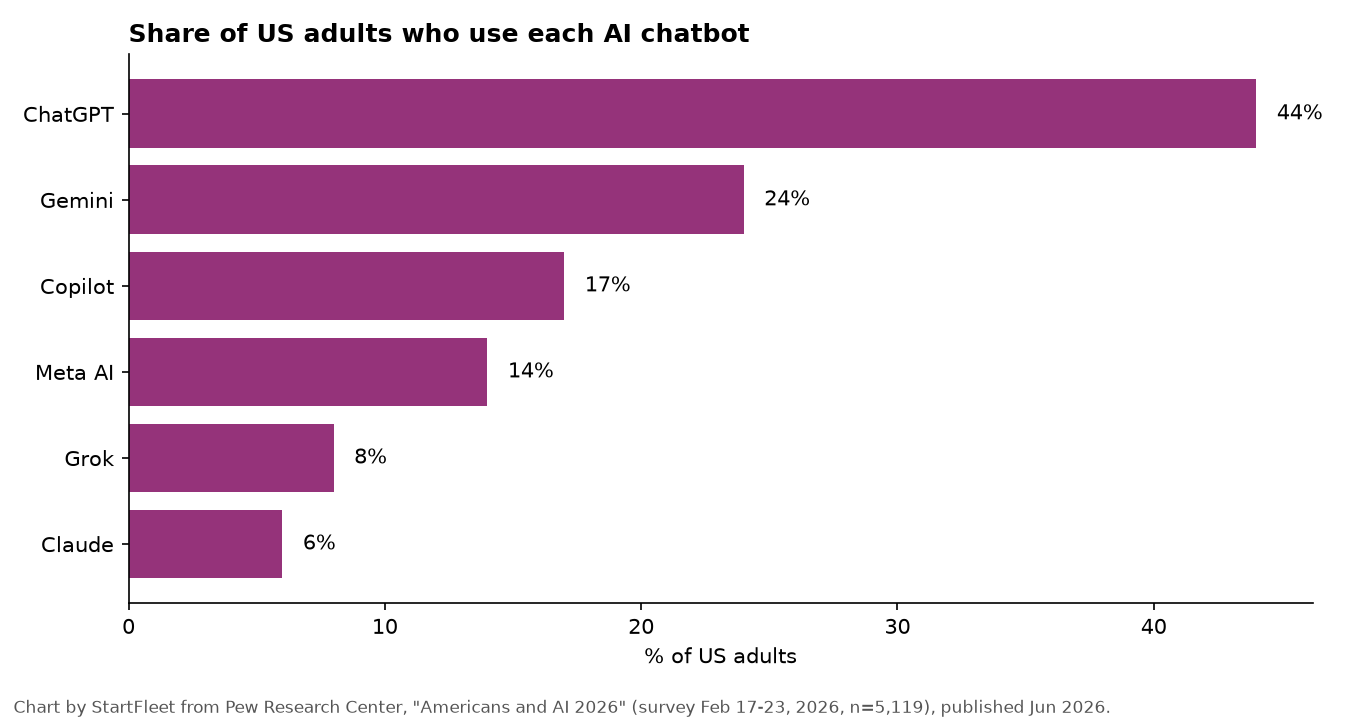
44% of US adults use ChatGPT, compared with 24% for Gemini and 6% for Claude (Pew Research Center, Jun 2026).
Anthropic and OpenAI together take 86% of enterprise LLM API spend, up from 67% a year earlier (Menlo Ventures, Nov 2026).
Open-source models handle 19% of enterprise AI tokens but only 4% of spend (Menlo Ventures, Nov 2026).
Qwen, the best-known Chinese open model, took just 0.8% of OpenRouter tokens in 2026 (OpenRouter, Nov 2026).
49% of US adults now use AI chatbots, up from 33% in 2024 (Pew Research Center, Jun 2026).
Only 4.5% of US consumers paid for ChatGPT, Gemini or Claude in August 2026, up from 2.1% a year earlier (a16z, Oct 2026).
Anthropic's run-rate revenue crossed $47 billion in May 2026 (Anthropic, May 2026).
Which AI assistants do the most people use?
ChatGPT is still the default AI for most people, and the gap to everyone else is wide. Gemini is the only rival close to its scale, helped by Google's distribution. Claude is a much smaller consumer brand than its business revenue suggests.
Figure 1: ChatGPT reaches almost twice as many US adults as Gemini and seven times as many as Claude. Source: Pew Research Center, Americans and AI 2026, Jun 2026 (survey fielded Feb 2026). Chart drawn by StartFleet from Pew's published figures, Nov 2026.
How many people use ChatGPT and Gemini?
Google reports monthly users and OpenAI reports weekly users, so the two counts are not directly comparable.
ChatGPT has about 1.2 billion weekly active users, according to a16z's consumer app report. OpenAI's own most recent count we could confirm was lower, so treat this as an estimate (a16z, Oct 2026).
ChatGPT draws about 2x the web visits of Gemini and about 6x those of Claude, based on Similarweb data (a16z, Oct 2026).
On mobile, ChatGPT has 2.5x Gemini's monthly active users and 14x Claude's, based on Sensor Tower data (a16z, Oct 2026).
Adults under 50 are about twice as likely as those 50 and older to use ChatGPT, 57% vs 28% (Pew Research Center, Jun 2026).
24% of US adults use an AI chatbot every day (Pew Research Center, Jun 2026).
Who is not using AI chatbots, and why?
77% of US adults aged 65 and older never use AI chatbots, and neither do 58% of those aged 50 to 64 (Pew Research Center, Oct 2026).
60% of non-users say lack of interest is a major reason they stay away (Pew Research Center, Oct 2026).
54% of non-users cite concern about how their personal information is used (Pew Research Center, Oct 2026).
67% of non-users say they are unlikely to start in the next 12 months (Pew Research Center, Oct 2026).
Which AI models do developers use most?
On OpenRouter, the consumer leaderboard flips. Developers routing API calls through it chose cheap, fast, open-weight models in 2026, and most of those come from China. OpenRouter is one marketplace, so treat this as a sample of developer behavior. It is useful because developers there can switch models with one line of code.
Figure 2: DeepSeek's 2026 token share on OpenRouter is more than double that of any US lab. Source: OpenRouter rankings, weekly token data Jan 5 to Nov 7, 2026, Nov 2026. Chart drawn by StartFleet from OpenRouter's data, pulled Nov 7, 2026.
Which AI companies process the most tokens on OpenRouter?
OpenRouter processed about 2,758 trillion tokens between January 5 and November 7, 2026, counting the labs its rankings name (OpenRouter, Nov 2026).
OpenAI was the largest US lab on OpenRouter in 2026, with 10.9% of tokens (OpenRouter, Nov 2026).
Z.ai, maker of the GLM models, took 8.9% (OpenRouter, Nov 2026).
The monthly number one by tokens in 2026 was Claude Sonnet 4.5 in January, MiniMax M2.5 in February, Xiaomi MiMo V2 Pro in March, Claude Sonnet 4.6 in April, DeepSeek V4 Flash in May and June, Xiaomi MiMo V2.5 in July, and a DeepSeek V4 or V4.1 Flash model from August onward. Claude Sonnet 4.6 in April was the last time a US model held the top spot (OpenRouter, Nov 2026).
Google was the top model maker every month from January to April 2026 and has not led a month since. DeepSeek has led every month from May (OpenRouter, Nov 2026).
In the week of November 2, 2026, DeepSeek took 39.1% of all OpenRouter tokens (OpenRouter, Nov 2026).
A single model, DeepSeek V4.1 Flash (October 17 release), took 27.3% of OpenRouter tokens that same week (OpenRouter, Nov 2026).
How much of OpenRouter traffic goes to open-weight models?
Open-weight models took 68.0% of OpenRouter tokens across 2026 (OpenRouter, Nov 2026).
Anthropic's share of OpenRouter tokens fell from 17.4% in January 2026 to 6.6% in the week of November 2. That is share, not volume: Anthropic's token count may still have grown (OpenRouter, Nov 2026).
Are Chinese AI models more popular than US models?
On OpenRouter, yes, and by a growing margin. Among consumers, no: ChatGPT and Gemini dominate. The popular framing "Qwen is beating ChatGPT" is wrong on both counts. The Chinese lead on OpenRouter comes from DeepSeek, Z.ai, Tencent and Xiaomi, not Qwen.
Figure 3: US labs went from two-thirds of OpenRouter tokens to under a quarter in ten months. Source: OpenRouter rankings, weekly token data Jan 5 to Nov 7, 2026, Nov 2026 (November is one partial week). Chart drawn by StartFleet from OpenRouter's data, pulled Nov 7, 2026.
How big is the Chinese lead in developer usage?
Moonshot AI, maker of Kimi, took 0.7% of OpenRouter tokens in 2026 (OpenRouter, Nov 2026).
Chinese open models overtook US-built open models in downloads and derivative models in summer 2025, according to a study of about 1,500 mainline open models (ATOM Report, Lambert and Brand, Apr 2026).
Chinese models make up 89% of enterprise open-source model spend: Kimi 61%, DeepSeek 15%, GLM 11% and Qwen 3% (Menlo Ventures, Nov 2026).
Meta's Llama is the most-used Western open-source model in enterprise, at 7% of open-source spend (Menlo Ventures, Nov 2026).
Why do developers pick Chinese models?
Price is the most likely reason, though OpenRouter's data does not record motive.
The average open-source token fell 3.3x in price to $0.13 per million, while closed-model tokens fell 24% to $0.70 per million (Menlo Ventures, Nov 2026).
Open-source token volume grew 22.5x in a year to an estimated 2.9 quadrillion tokens a month, against 12.1x growth for closed models (Menlo Ventures, Nov 2026).
Near-frontier models, including xAI's Grok 4.7, Kimi K3, DeepSeek V4 and GLM-5.3, together hold just under 5% of enterprise LLM API spend (Menlo Ventures, Nov 2026).
Which AI models do businesses pay for?
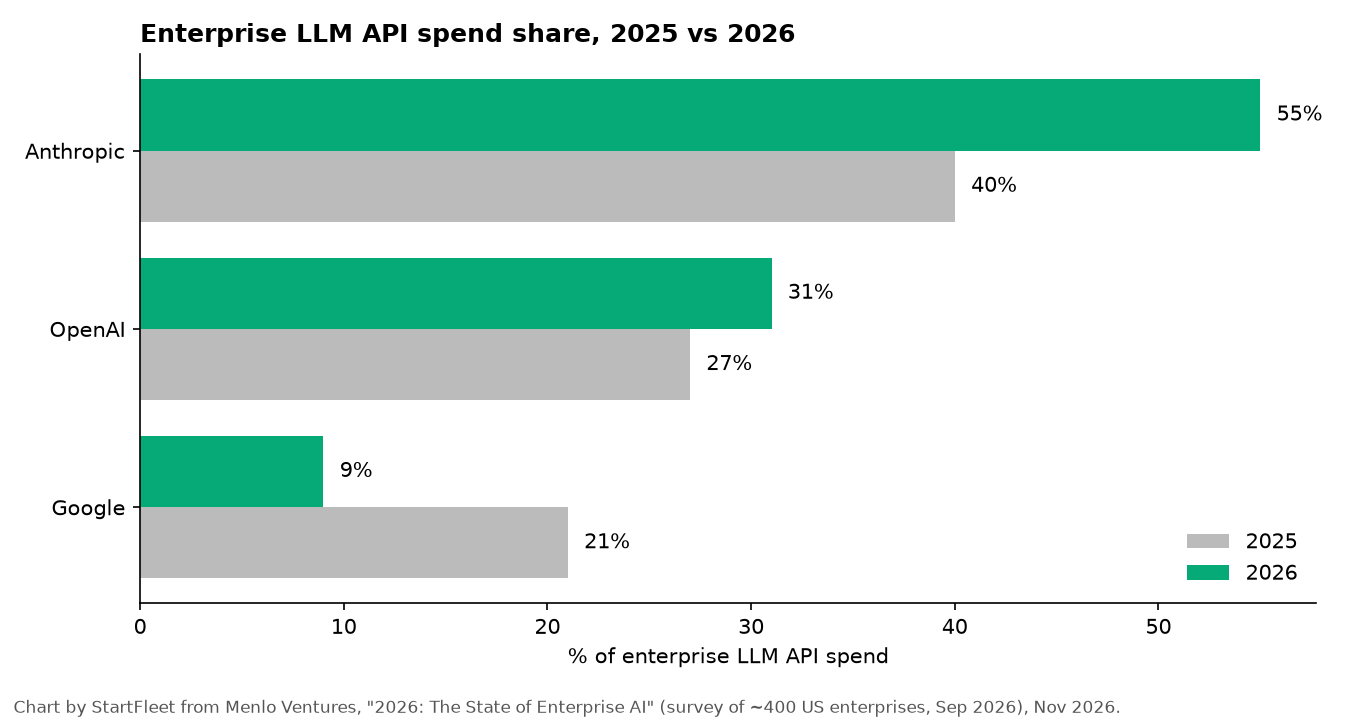
Usage and money point in opposite directions. Cheap open models win on token counts; Anthropic and OpenAI win on spend, because enterprises pay for the most capable models on their hardest work.
Figure 4: Anthropic grew its lead in enterprise API spend while Google's share more than halved. Source: Menlo Ventures, 2026: The State of Enterprise AI, Nov 2026 (survey fielded Sep 2026). Chart drawn by StartFleet from Menlo's published figures, Nov 2026.
What share of enterprise API spend does each lab get?
Anthropic holds 55% of enterprise LLM API spend, up from 40% a year earlier (Menlo Ventures, Nov 2026).
OpenAI holds 31%, up from 27% (Menlo Ventures, Nov 2026).
Google holds 9%, down from 21% (Menlo Ventures, Nov 2026).
Enterprise AI deployment spend reached $177 billion by September 2026, up from $33 billion a year earlier (Menlo Ventures, Nov 2026).
Agent traffic on OpenRouter overtook human traffic in February 2026 and has grown 37x since (Menlo Ventures, Nov 2026).
How much are the AI labs earning?
Anthropic raised $65 billion at a $965 billion post-money valuation (Anthropic, May 2026).
Google's first-party model APIs process about 32 billion tokens per minute, up 40% on the previous quarter (Alphabet, Oct 2026).
Google's API tokens per minute are more than 4x what they were a year earlier (Alphabet, Oct 2026).
How many consumers pay for AI?
ChatGPT has 3x as many US consumer paid subscribers as Claude or Gemini (a16z, Oct 2026).
8% of US ChatGPT subscribers also pay for Claude (a16z, Oct 2026).
7.3% of Claude's consumer payers are on the $100-a-month Max plan, compared with 1.3% for Google and 1.1% for ChatGPT on comparable tiers (a16z, Oct 2026).
The median AI payer spends $25 a month, and the top 1% of payers account for 19.5% of spend (a16z, Oct 2026).
If you are building an AI product from outside the US, the paying customers in these numbers mostly expect to buy from a US business with US payment rails. StartFleet sets up the US LLC, EIN and banking that let you bill them.
What do people use AI models for?
A large share of AI use is personal. Both OpenAI's and Anthropic's usage studies find it, and explanations and information-seeking top the list of what people ask for.
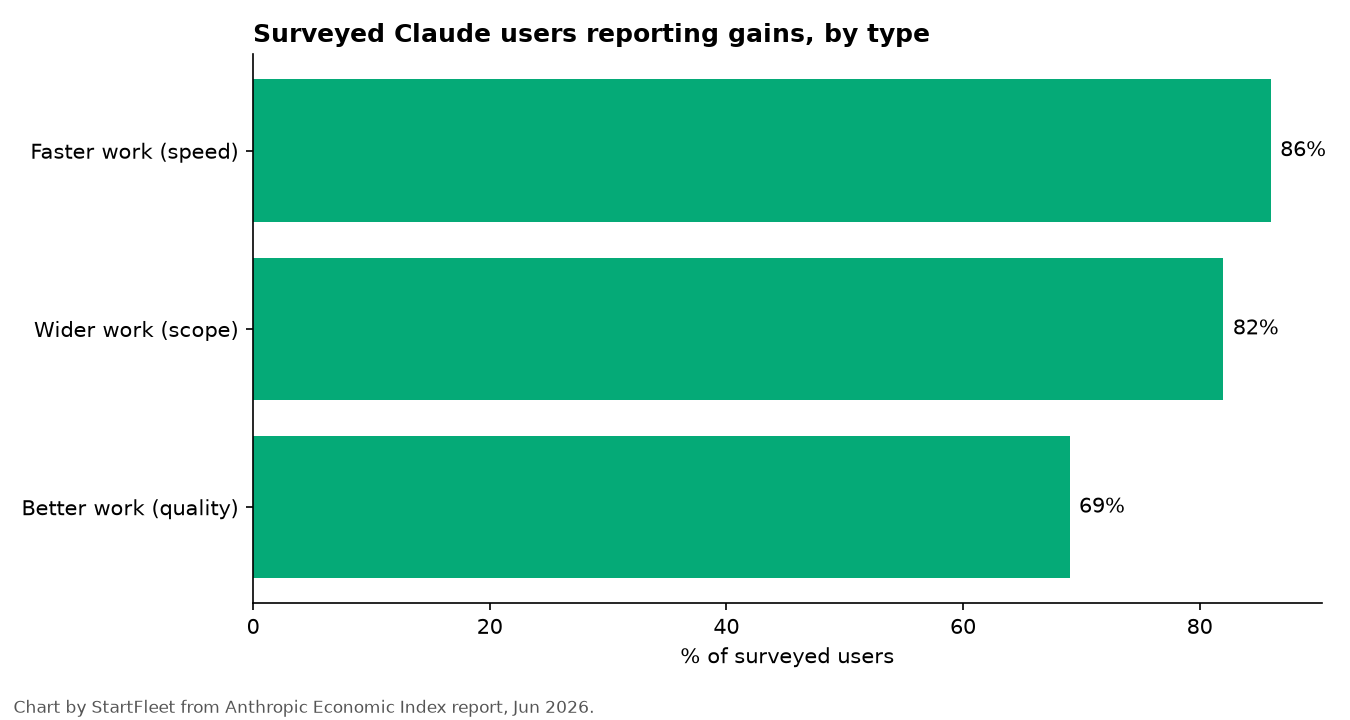
Figure 5: Most surveyed Claude users say AI speeds up their work; fewer say it improves quality. Source: Anthropic Economic Index report, Jun 2026. Chart drawn by StartFleet from Anthropic's published figures, Nov 2026.
How do people use Claude?
Personal use makes up about 35% of Claude conversations on weekdays and just under 50% on weekends (Anthropic, Jun 2026).
93% of Claude conversations produce an artifact, such as an explanation, document or piece of code (Anthropic, Jun 2026).
Explanations are the most common artifact at 17%, followed by documents and reports at 15% and guidance at 11% (Anthropic, Jun 2026).
Opus, Anthropic's largest model, serves 54% of Claude Code sessions but only 10% of chat conversations (Anthropic, Jun 2026).
68% of surveyed Claude users say they learn more with AI (Anthropic, Jun 2026).
How do people use ChatGPT?
OpenAI's study covers data to July 2025, so it is older than the rest of this page.
ChatGPT reached about 10% of the world's adult population by July 2025 (NBER, How People Use ChatGPT, Sep 2025).
Practical guidance, seeking information and writing account for nearly 80% of ChatGPT conversations (NBER, How People Use ChatGPT, Sep 2025).
How do Americans use AI at work and in search?
38% of employed US adults use chatbots for work tasks (Pew Research Center, Jun 2026).
42% of US adults use chatbots to search for information (Pew Research Center, Jun 2026).
Queries in Google's AI Mode are on average 3x longer than traditional searches (Alphabet, Oct 2026).
1 in 5 AI Mode searches use voice, images or documents (Alphabet, Oct 2026).
Methodology and Sources
We cite only the organization that produced each number: the AI company's own filing or post, the survey firm, or the researchers. We do not cite statistics roundups.
The OpenRouter figures are our own analysis. We pulled OpenRouter's public weekly rankings data (token share by model maker, by model, and open vs closed) on November 7, 2026 and summed the weeks from January 5 to November 7, 2026. Read them with these limits:
They measure tokens processed, not users, requests or dollars. Cheap models generate more tokens per dollar, so they look bigger by this measure.
They cover traffic routed through OpenRouter only. They do not include ChatGPT, Claude or Gemini app users, or API traffic sent directly to OpenAI, Anthropic or Google. Free and low-cost models are over-represented.
12.4% of 2026 tokens sit in an unlabeled "Others" group and 2.9% went to unnamed "stealth" test models, so the China and US shares do not add up to 100%.
The week of November 2, 2026 was still in progress when we pulled the data.
We grouped model makers by headquarters: China (DeepSeek, Z.ai, Tencent, Xiaomi, MiniMax, StepFun, Qwen, Moonshot AI) and US (OpenAI, Anthropic, Google, NVIDIA, xAI, Meta, Arcee AI, Poolside, OpenRouter).
Menlo Ventures is an investor in both Anthropic and OpenRouter, and its spend shares come from a survey of about 400 US enterprises. a16z's app figures are based on Similarweb, Sensor Tower and YipitData data, and its ChatGPT weekly user count is not an OpenAI disclosure. Google reports monthly users and OpenAI reports weekly users, so we do not rank them against each other. Pew notes that its 2024 and 2026 chatbot questions were worded differently.
We refresh this page monthly.
Glossary
Token: a chunk of text, roughly three-quarters of a word, that AI models read and write. API usage is billed per token.
API: application programming interface, the way software calls an AI model directly instead of through a chat app.
Open-weight model: a model whose trained weights are published, so anyone can download and run it.
OpenRouter: a marketplace that lets developers reach hundreds of AI models through one API.
MAU / WAU: monthly or weekly active users.
Run-rate revenue: current revenue annualized, usually the latest month times 12.
StartFleet Team shares insights and guides on U.S. business, company formation, EINs, taxes, and banking for non-U.S. founders. Our guides are written by the team that handles these filings every day, so you get advice from people who do this work.
Building an online business is a lonely endeavor. Join our newsletter to get stories of successful global entrepreneurs on how they build their online business.
Thank you! Your submission has been received!
Oops! Something went wrong while submitting the form.