"90% of startups fail" is the most repeated number in startup writing, and we couldn't find a primary study behind it. What the data does show is narrower and more useful: why venture-backed startups shut down, how long their money lasts, and which kinds of companies are closing in 2026.
The timing makes this a strange year to measure. Venture funding is at record levels, yet most of it is going to a small number of AI companies, and older software startups are closing at a faster pace. Every figure below links to the company or agency that collected the data, and each one is dated, because startup numbers go stale fast.
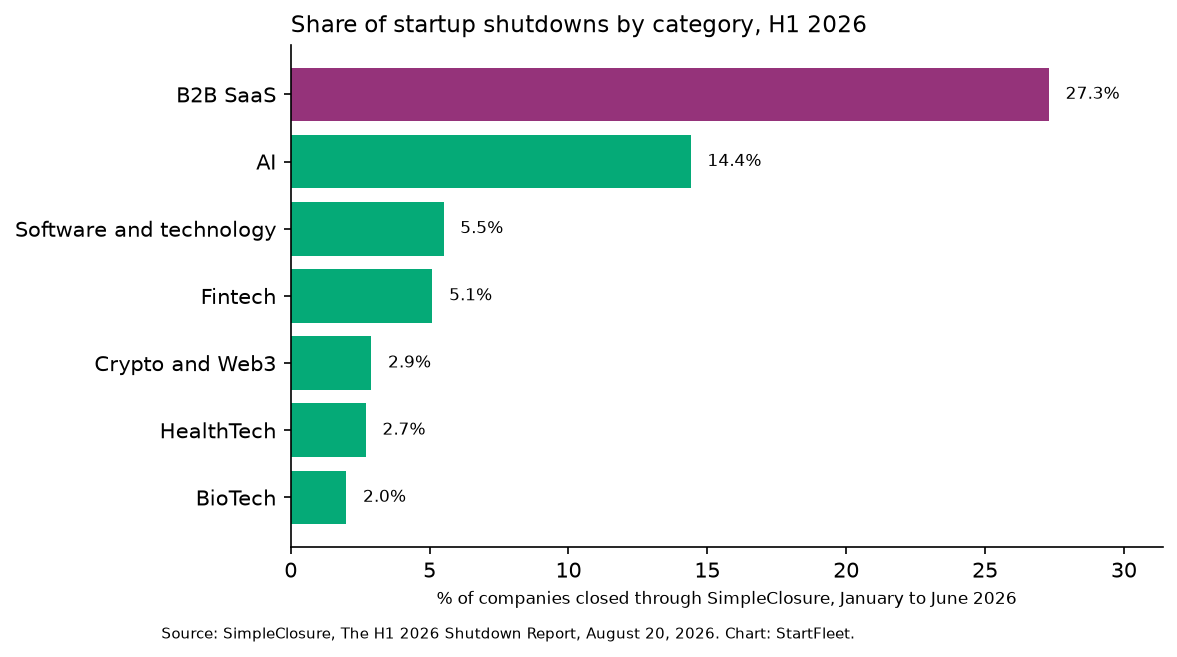
B2B SaaS companies made up 27.3% of startup shutdowns in the first half of 2026, nearly twice the share of AI companies (SimpleClosure, The H1 2026 Shutdown Report, Aug 2026).
No one counts every startup failure, so be wary of anyone who gives you one precise rate. What we have are shutdown counts from data providers and government survival rates for all new businesses. Together they say most new businesses don't last five years, and VC-backed ones fail in public far less often than they quietly stall.
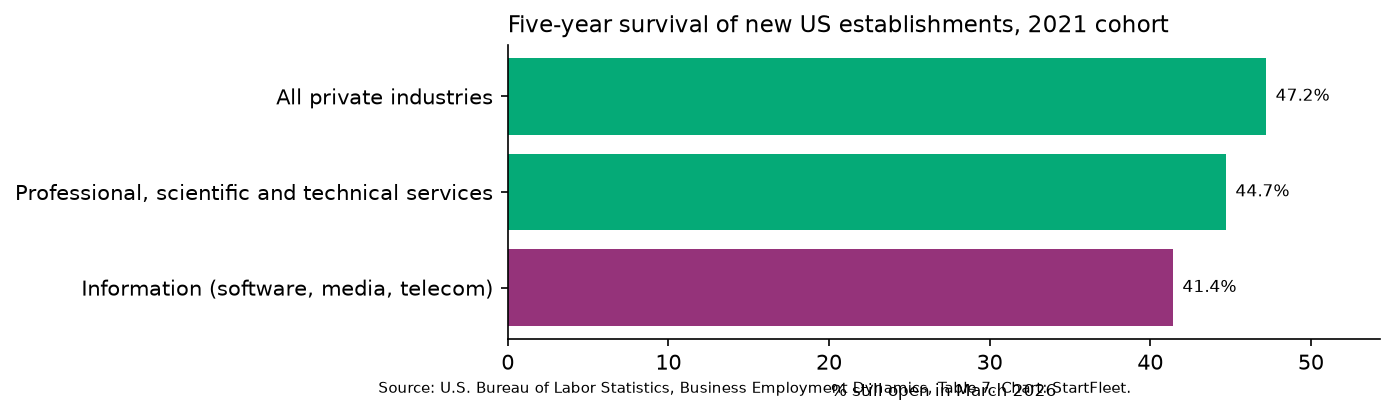
Figure 1: The sectors where most tech startups sit have the weakest five-year survival of any industry in the BLS tables. Source: U.S. Bureau of Labor Statistics, Establishment Age and Survival Data, Oct 2026, data through March 2026. Chart drawn by StartFleet from the BLS Table 7 files, November 7, 2026.
What share of new businesses fail within five years?
Slightly more than half of all new US businesses close within five years, and tech-heavy sectors do worse.
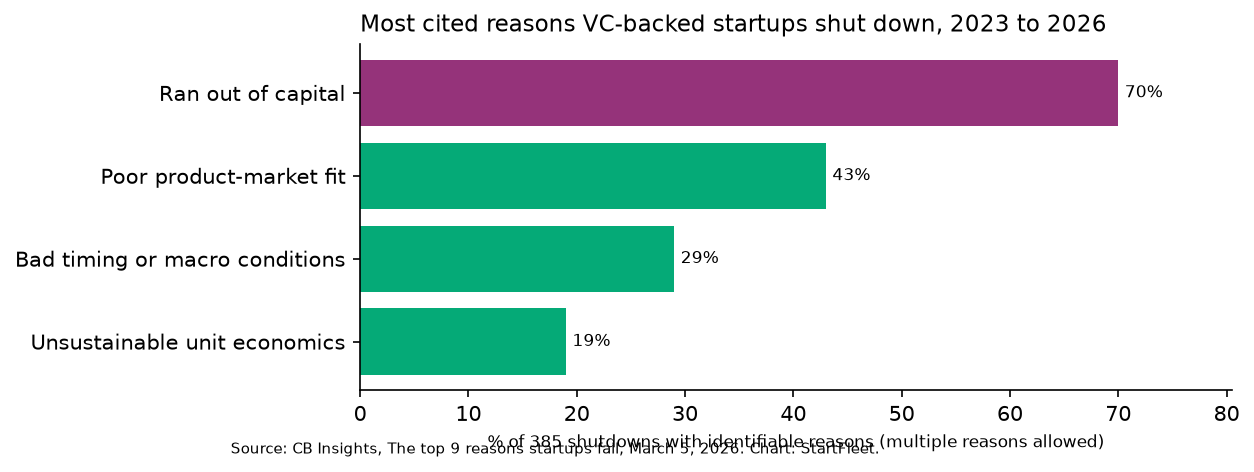
CB Insights identified 431 VC-backed startups that publicly shut down from 2023 to early 2026, excluding companies with a prior exit (CB Insights, The top 9 reasons startups fail, Mar 2026).
Running out of money is how almost every startup dies, but it's rarely the reason. The money runs out because the product didn't find enough buyers, the timing was wrong or each sale lost money.
Figure 2: Capital tops the list because it's the final cause in nearly every shutdown, while product-market fit is the most common root cause. Source: CB Insights, The top 9 reasons startups fail, Mar 2026. Chart drawn by StartFleet from the figures on the source page, November 7, 2026.
What are the top reasons startups fail?
After running out of capital, the most common causes are a weak market, bad timing and poor unit economics.
What are the warning signs before a startup fails?
Shrinking teams and fading partnerships usually show up a year before the shutdown notice.
72% of failed startups with full data saw their CB Insights Mosaic health score fall in the year before they closed, by 15% on average (CB Insights, The top 9 reasons startups fail, Mar 2026).
In 2026, the companies closing are mostly pre-AI software businesses that raised in 2021 and 2022, not the new AI startups. The AI cohort is too young to show up in the shutdown data yet.
Figure 3: B2B SaaS shutdowns outnumbered AI shutdowns nearly two to one, even though AI took most of the year's venture money. Source: SimpleClosure, The H1 2026 Shutdown Report, Aug 2026. Chart drawn by StartFleet from the figures on the source page, November 7, 2026.
Are AI startups failing?
Not yet in large numbers. Their share of shutdowns has fallen for two years.
AI companies were 14.4% of the startups SimpleClosure closed in H1 2026, down from 15.9% in 2025 and 17.7% in 2024 (SimpleClosure, The H1 2026 Shutdown Report, Aug 2026).
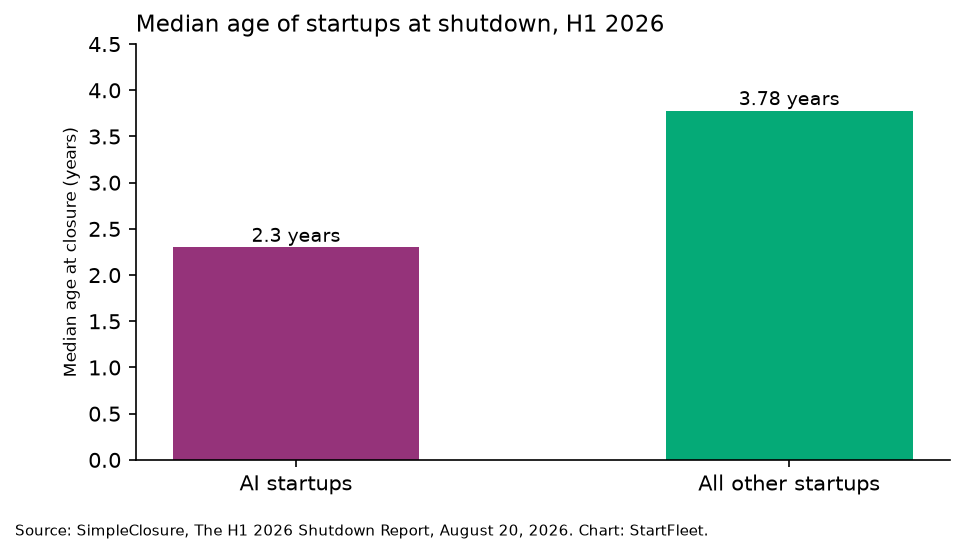
Most failed startups get about two years from their last raise. The money they raised doesn't predict how long they last, and some of the best-funded companies were among the biggest failures.
Figure 4: AI startups that closed were about a year and a half younger than other closures, mostly because the AI cohort was founded later. Source: SimpleClosure, The H1 2026 Shutdown Report, Aug 2026. Chart drawn by StartFleet from the figures on the source page, November 7, 2026.
How much runway do startups have after their last raise?
AI startups that closed still had a median $30,000 in the bank, more than double the $13,000 median for other startups (SimpleClosure, The H1 2026 Shutdown Report, Aug 2026).
Closing a US company properly takes work too. Delaware still expects its franchise tax return and the IRS still expects final filings after you stop trading. If you're a founder outside the US, StartFleet's formation plans include a registered agent, so state and IRS notices reach you while the company is open.
Is it harder for startups to survive in 2026?
Yes for most of them, even with record funding. The money is real, but it's going to fewer companies, and the ones left out are the ones that end up closing.
Figure 5: Half a year of 2026 funding already beat every full year since 2016, but it went into fewer, larger rounds. Source: PitchBook-NVCA Venture Monitor, Q2 2026, Aug 2026, data as of June 30, 2026. Chart drawn by StartFleet from the figures in the source PDF, November 7, 2026.
Startups on Carta raised more than $100 billion over Q2 and Q3 2026, the strongest six months since late 2021 and early 2022 (Carta, State of Private Markets: Q3 2026, Nov 2026).
How much of the money goes to AI?
Most of it, and the gap in valuations is wide.
About 57% of capital invested at Series B and later on Carta in 2026 went to AI startups, the highest share on record (Carta, State of Private Markets: Q3 2026, Nov 2026).
An AI foundation model startup at Series A might raise at a $300 million median valuation, against $55 million for a non-AI startup (Carta, State of Private Markets: Q1 2026, May 2026).
Bay Area startups took more than 40% of all cash raised on Carta in 2026, more than three times New York's share (Carta, State of Private Markets: Q3 2026, Nov 2026).
Every number comes from the organization that collected it: CB Insights' shutdown database, SimpleClosure's dissolution records, Carta's cap-table data, the PitchBook-NVCA Venture Monitor and the BLS survival tables. We didn't use statistics roundups. These sources measure different things. CB Insights counts public shutdowns of VC-backed companies, SimpleClosure counts only companies it helped dissolve, Carta covers startups using its platform, and BLS covers every new business with employees. Read each figure in its own context rather than adding them together. We refresh this page monthly as new quarterly data comes out.
Glossary
VC: venture capital.
Product-market fit: when enough customers want a product badly enough to pay for it at a price that sustains the business.
Down round: a funding round priced below the company's previous valuation.
Zombie startup: a company that is still operating but can't raise new money or find a buyer.
Runway: how long a startup's cash lasts at its current spending rate.
Unit economics: the revenue and cost of serving one customer or selling one unit.
StartFleet Team shares insights and guides on U.S. business, company formation, EINs, taxes, and banking for non-U.S. founders. Our guides are written by the team that handles these filings every day, so you get advice from people who do this work.
Building an online business is a lonely endeavor. Join our newsletter to get stories of successful global entrepreneurs on how they build their online business.
Thank you! Your submission has been received!
Oops! Something went wrong while submitting the form.