How many Americans freelance? It depends on who's counting, and the answers run from about 9 million to nearly 75 million. Government surveys count people whose main job is self-employment. Industry surveys count anyone who earned independent income in the past year. Both are right about different things, so this page keeps every number tied to the source that measured it.
The 2026 data points one way. More skilled workers are freelancing, AI is splitting freelance pay into a cheap tier and an expensive one, and the biggest marketplaces are losing small buyers while the clients who stay spend more. Most freelancers still work as sole proprietors with no separate legal entity.
Every figure below links to the organization that ran the survey or filed the report.
Somewhere between 9 million and 75 million, depending on the definition. Official counts only see people whose main job is self-employment. Industry surveys catch side work too, and that's where most of the recent growth sits.
Figure 1: Skilled freelancing jumped 10 points in a single year, the sharpest move in any measure on this page. Source: Upwork Research Institute, The Future Workforce Index 2026, Jul 2026. Chart published by the source, captured November 7, 2026.
Nearly 12 million Americans are independent service professionals building businesses around specialized expertise (MBO Partners, State of Independence 2026, Sep 2026).
Counting the "missing self-employed" that standard surveys overlook raises the share of workers self-employed on their main job by nearly 50% (W.E. Upjohn Institute, The Missing Self-Employed, May 2026).
Is freelancing a stopgap or a career?
55% of independent workers say entrepreneurial ambition pushed them into it, while 51% cite economic need (Quicken, independent worker survey, May 2026).
Very few run their work through a separate legal entity. Most freelancers are sole proprietors by default: they file a Schedule C and their business has no legal existence apart from them. That's cheap and simple, and it also means no liability shield and nothing a bank or platform can verify as a company.
Figure 2: Nonemployer firms, the legal home of most freelancers, nearly doubled in 25 years while employer firms barely moved. Source: SBA Office of Advocacy, Frequently Asked Questions About Small Business, Feb 2026 (Census NES and SUSB data through 2022). Screenshot of the source PDF, captured November 7, 2026.
The Census Bureau's newest count, covering 2024, comes from IRS business income tax records of firms with no paid employees and at least $1,000 in receipts (U.S. Census Bureau, 2024 Nonemployer Statistics, Sep 2026).
A single-member LLC is taxed as a sole proprietorship by default, so some LLC owners sit inside that 86.7% figure. The tax data can't separate them. If you freelance from outside the US and want a US entity for banking or payment platforms, our LLC formation guide for non-residents walks through the steps.
How much do freelancers earn?
Freelancers can out-earn employees, but the money arrives unevenly, and the uneven months cost them. The Fed's data shows how much more often the self-employed deal with irregular income than employees do.
Figure 3: Self-employed adults were twice as likely as employees to see their income swing month to month, and more than twice as likely to struggle with bills because of it. Source: Federal Reserve Board, Economic Well-Being of U.S. Households in 2025, May 2026. Screenshot of the source PDF, captured November 7, 2026.
Self-employed workers spend an extra 5 to 8 percentage points of gross pay on unreimbursed expenses compared with employees (NBER Working Paper 34843, Feb 2026).
81% of independent workers say they have sacrificed health, sleep or family time to keep their business going (Quicken, independent worker survey, May 2026).
38% of those who dropped health insurance did so because they could no longer afford the premiums (Quicken, independent worker survey, May 2026).
How is AI changing freelance work?
AI is cutting the price of simple output and raising the price of judgment. Freelancers who sell finished text, images or video are losing ground, while freelancers who wire AI into real business work are pulling ahead.
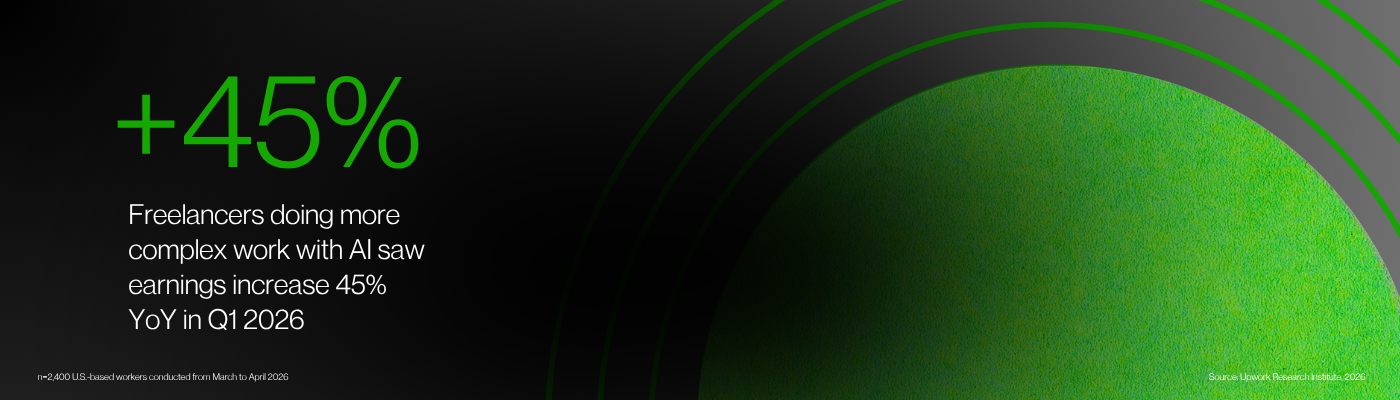
Figure 4: Complex AI-augmented work is where freelance earnings are growing fastest, even as simple AI output gets cheaper. Source: Upwork Research Institute, The Future Workforce Index 2026, Jul 2026. Chart published by the source, captured November 7, 2026.
Gross services volume from freelancers with AI skills grew 55% year over year, to an annualized run rate of nearly $450 million (Upwork, Third Quarter 2026 Results, Nov 2026).
Fiverr cut its 2026 guidance, citing persistent weakness in categories most exposed to AI automation and expecting full-year revenue to fall 14% to 17% (Fiverr, Second Quarter 2026 Results, Jul 2026).
35% of independent workers believe AI will force them to keep changing their skills just to hold their income (Quicken, independent worker survey, May 2026).
Are clients hiring AI agents instead of freelancers?
AI agents made nearly 50 million requests to Upwork's MCP server after its August 2026 launch (Upwork, Third Quarter 2026 Results, Nov 2026).
The two listed marketplaces are getting smaller at the bottom and richer at the top. Both are losing the occasional buyer of a $50 logo and keeping the business that spends thousands.
81% of executives at leading-edge organizations strongly agree independent talent gives them access to high-value skills (MBO Partners, State of Independence 2026, Sep 2026).
61% of independent professionals rate schedule flexibility as very important, but only 36% of enterprises recognize it as such (MBO Partners, State of Independence 2026, Sep 2026).
25% of Gen Z independent workers have already been deactivated or lost access to a platform they relied on for income (Quicken, independent worker survey, May 2026).
How many freelancers are there worldwide?
Nobody has a current global headcount. The best estimate is still the World Bank's 2023 study. The main 2026 development was the first global labor treaty for platform work.
The convention covers platform workers whether or not they are employees, including the self-employed, and asks member states to facilitate registration of self-employed platform workers (International Labour Organization, Convention No. 193 explainer, Jun 2026).
Lifted, Upwork's enterprise arm, bought employer-of-record WorkMotion to directly employ contingent talent in more than 30 countries (Upwork, Third Quarter 2026 Results, Nov 2026).
Methodology and Sources
We included a statistic only if we could open the original report, filing or dataset, find the number on the page and confirm its date. Every link points to the organization that produced the data, never to a statistics roundup. We prefer 2026 sources and keep two older ones, the BLS Contingent Worker Survey (fielded July 2023) and the World Bank's 2023 gig study, because nothing newer measures the same thing. Survey definitions differ, so we don't add or compare figures across sources. This page is reviewed monthly.
Glossary
GSV (gross services volume): total client spend on a marketplace, before the platform's cut.
Take rate: the share of transaction value a marketplace keeps as revenue.
Nonemployer business: a firm with no paid employees that files business income taxes, as counted by the Census Bureau.
Sole proprietorship: a business owned by one person with no separate legal entity.
LLC (limited liability company): a state-registered entity that separates business liability from the owner.
Contingent worker: someone whose job is not expected to last, per BLS.
MCP (Model Context Protocol): a standard that lets AI agents connect to outside services.
StartFleet Team shares insights and guides on U.S. business, company formation, EINs, taxes, and banking for non-U.S. founders. Our guides are written by the team that handles these filings every day, so you get advice from people who do this work.
Building an online business is a lonely endeavor. Join our newsletter to get stories of successful global entrepreneurs on how they build their online business.
Thank you! Your submission has been received!
Oops! Something went wrong while submitting the form.